

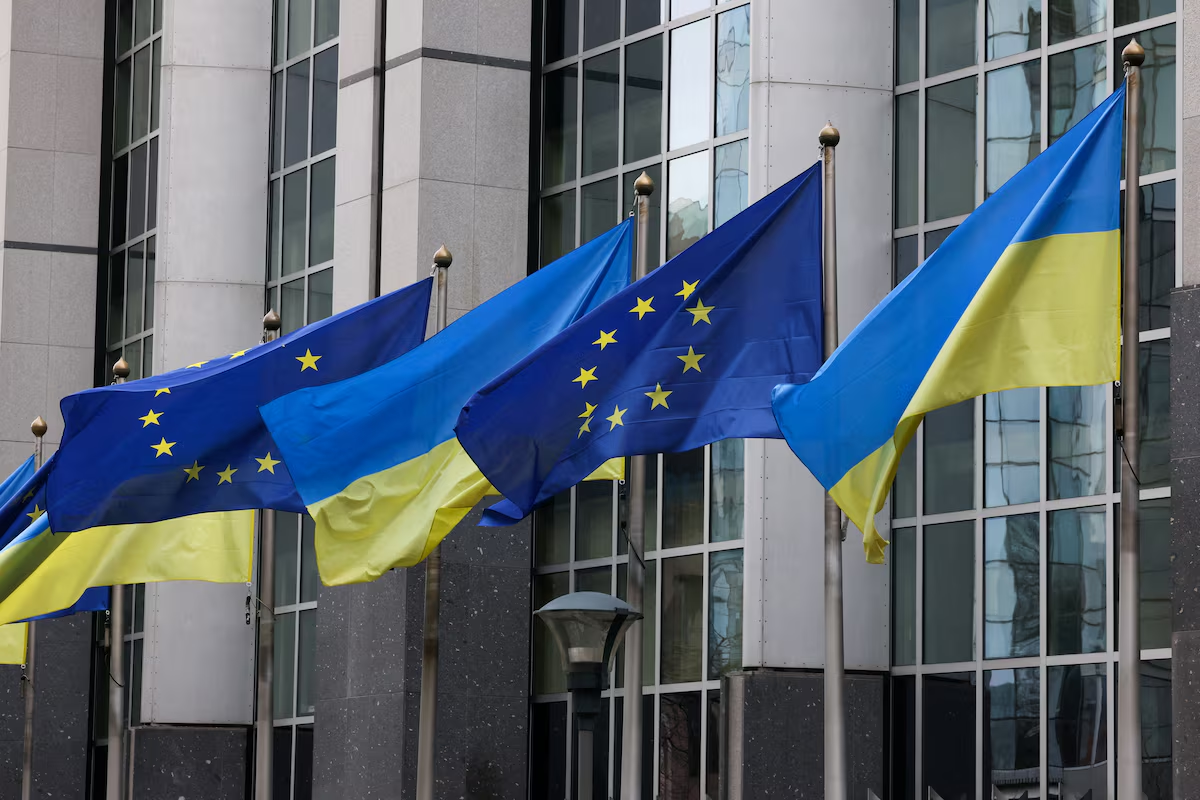
The European Union’s effort to leverage frozen Russian sovereign assets in response to the ongoing Ukraine conflict has encountered serious legal, political, and economic obstacles. What began as an ambitious proposal to repurpose billions in immobilized Russian funds has evolved into a more cautious financial arrangement, underscoring the complexity of balancing geopolitical objectives with international law and financial stability.
Since 2022, the EU and its allies have frozen hundreds of billions of euros in Russian central bank reserves and state-linked assets as part of sanctions imposed following Russia’s invasion of Ukraine. The majority of these assets are held within European financial systems, particularly in major clearing institutions. While freezing assets is a long-established sanctions tool, the question of whether those funds can be seized or used has proven far more controversial.
Legal Barriers and Sovereign Immunity

At the heart of the debate lies the principle of sovereign immunity, a cornerstone of international financial law that protects state assets from confiscation by foreign governments. Several EU member states raised concerns that outright seizure of Russian assets could violate international law, expose national governments and financial institutions to lawsuits, and set a precedent that may later be used against European states.
Legal experts have warned that confiscation could undermine trust in Europe as a safe custodian of foreign reserves. Central banks around the world rely on the assumption that sovereign assets held abroad remain protected even during political disputes. Breaching that assumption could encourage countries to diversify away from European financial systems, reducing the EU’s influence in global finance.
Internal Divisions Within the European Union
The proposal to use frozen Russian assets revealed deep divisions among EU member states. While some governments strongly supported using the funds to support Ukraine’s defense and reconstruction, others urged restraint, emphasizing legal risk, financial stability, and long-term reputational damage.
Countries hosting large portions of the frozen assets expressed particular caution, noting that financial clearing systems could become targets of retaliatory claims or economic countermeasures. The requirement for unanimous approval among EU members further complicated the process, making it difficult to advance a legally aggressive approach.
Shift Toward a Financial Compromise
Facing resistance, EU leaders ultimately agreed on a compromise that stops short of asset confiscation. Instead, the bloc approved a substantial financial assistance package for Ukraine, structured as long-term loans backed by the EU budget. While these loans may be politically linked to the frozen Russian assets, the funds themselves remain immobilized rather than transferred.
Additionally, the EU moved to extend the freeze on Russian assets indefinitely, eliminating the need for periodic renewal votes. This decision ensures that the assets remain inaccessible to Russia while avoiding the legal threshold of permanent seizure.
Global Financial Implications

The controversy has sparked widespread discussion beyond Europe. International investors, central banks, and sovereign wealth funds are closely watching how the EU navigates this issue. The handling of Russian assets has raised broader concerns about the security of foreign reserves and the politicization of global financial infrastructure.
If sovereign assets can be repurposed during geopolitical conflicts, some analysts argue, countries may increasingly seek alternatives to traditional reserve currencies or relocate holdings to jurisdictions perceived as more neutral. Such shifts could weaken the dominance of European and Western financial institutions over time.
Russian Response and Geopolitical Risks
Russia has consistently condemned any attempt to confiscate its assets, calling such actions unlawful and warning of reciprocal measures. Potential retaliation could include legal claims, asset seizures involving European companies, or further fragmentation of global financial systems.
These risks have reinforced the EU’s cautious stance, as leaders seek to avoid escalation that could have unintended economic consequences for Europe itself.
A Delicate Balancing Act
The EU’s handling of frozen Russian assets highlights the tension between moral responsibility, political pressure, and legal reality. While there is broad support for aiding Ukraine, there is far less agreement on how far international norms can be stretched to achieve that goal.
The current approach reflects a strategic compromise: maintaining pressure on Russia through asset immobilization while providing Ukraine with substantial financial assistance through conventional mechanisms. Whether this balance will hold over time remains uncertain, particularly as reconstruction costs rise and political dynamics evolve.
Conclusion
The frozen Russian asset debate represents a pivotal moment for the European Union’s global credibility. How the EU manages these funds will influence not only the outcome of the Ukraine conflict but also long-term confidence in international financial law and Western economic leadership. For now, caution has prevailed over confrontation, but the issue remains unresolved, and its consequences will shape global finance for years to come.

