


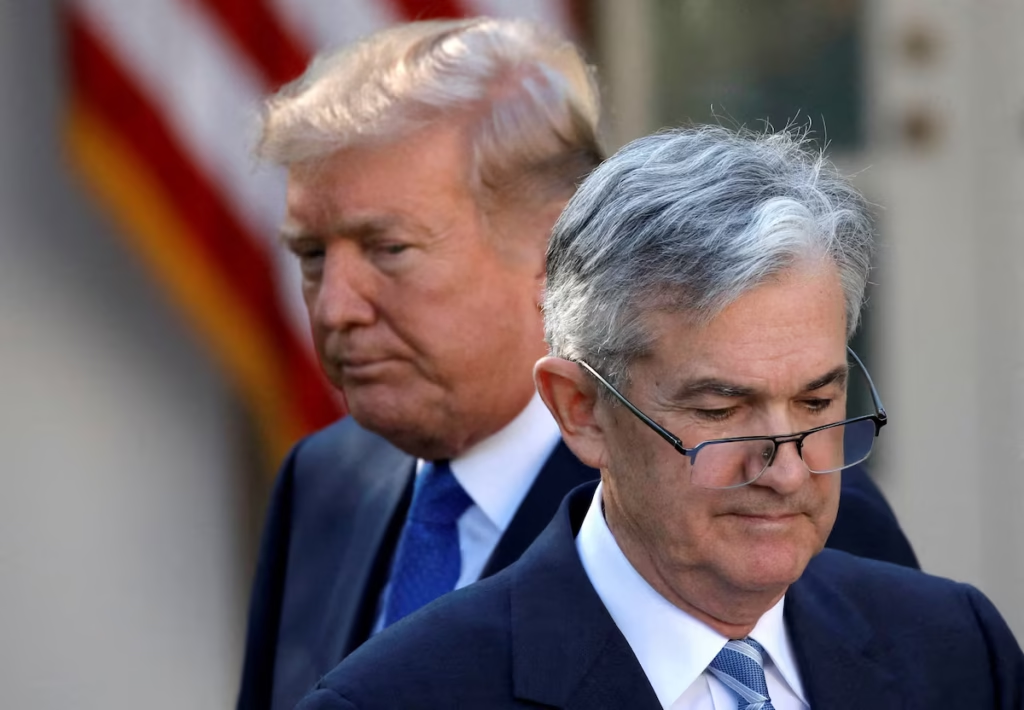
Global financial markets are facing renewed uncertainty as tensions escalate between former President Donald Trump and Federal Reserve Chair Jerome Powell. The dispute has reignited concerns over political interference in monetary policy and raised a critical question for investors: is it time to reconsider exposure to U.S. assets?
At the heart of the turmoil is a criminal investigation involving Powell related to his congressional testimony about the Federal Reserve’s costly headquarters renovation. Powell has strongly denied wrongdoing and characterized the investigation as politically motivated, suggesting it is designed to pressure the central bank into cutting interest rates. These claims have amplified market anxiety, particularly because central bank independence has long been regarded as a pillar of U.S. economic credibility.
The Federal Reserve’s autonomy is essential to maintaining investor confidence, managing inflation expectations, and supporting the U.S. dollar’s status as the world’s primary reserve currency. Any perception that political forces are influencing monetary policy decisions can have wide-ranging consequences across equities, bonds, and foreign exchange markets.
Market Signals Point to Rising Unease
Financial markets have already begun to reflect growing investor unease. U.S. equities have experienced increased volatility as traders reassess political risk alongside economic fundamentals. Meanwhile, the U.S. dollar has weakened against major global currencies, signaling concerns about policy stability and institutional integrity.
At the same time, Treasury yields have moved higher as bond prices decline, suggesting that investors are demanding greater compensation for holding U.S. government debt. This shift is particularly notable given that Treasuries are traditionally viewed as one of the safest assets in the world. When bonds, stocks, and the currency all face pressure simultaneously, it often points to deeper structural concerns rather than short-term market noise.
Adding to the picture, demand for traditional safe-haven assets such as gold has surged. Investors tend to move into precious metals during periods of political and monetary uncertainty, and the recent price action suggests that many market participants are seeking protection against potential instability in U.S. policy leadership.
The Return of the “Sell America” Narrative
These developments have revived talk of a potential “Sell America” trade a scenario in which global investors reduce exposure to U.S. assets in favor of alternatives such as European equities, emerging market currencies, or commodities. While such shifts are rarely immediate or absolute, even modest reallocations can have meaningful effects on asset prices and capital flows.
Historically, the United States has benefited from strong institutions, transparent governance, and a clear separation between politics and monetary policy. These factors have made U.S. markets a default destination for global capital, especially during times of crisis. Any erosion of this perception could weaken the country’s long-standing financial advantages.
Institutional investors and global central banks are particularly sensitive to these dynamics. Concerns over the Federal Reserve’s independence may prompt some long-term investors to diversify reserves or portfolios away from U.S. assets, even if only incrementally.
Broader Economic and Political Implications
The dispute also arrives at a delicate moment for the U.S. economy. Inflation remains a key concern, economic growth is slowing from post-pandemic highs, and financial markets are closely watching the Federal Reserve’s next moves on interest rates. Political pressure to cut rates prematurely could risk reigniting inflation, undermining the central bank’s credibility in the process.

Prominent financial leaders have publicly emphasized the importance of protecting the Fed’s independence, warning that politicizing monetary policy could lead to long-term economic damage. International observers have echoed these concerns, noting that the credibility of the U.S. financial system has global implications.
Adding another layer of uncertainty is the approaching end of Powell’s term as Fed chair. Speculation over potential successors and future policy direction has intensified, making markets even more sensitive to political developments.
What Investors Should Watch
For investors, the situation underscores the growing importance of political risk in portfolio decisions. Key factors to monitor include the trajectory of the investigation involving Powell, official communications from the Federal Reserve, and any shifts in rhetoric or policy direction related to interest rates.
Capital flows into and out of U.S. equities, bonds, and the dollar will also provide critical signals. Sustained outflows could indicate that investor confidence is weakening, while stabilization may suggest that markets view the current tensions as temporary.
Conclusion
While it may be premature to declare a full-scale “Sell America” moment, the clash between Donald Trump and Jerome Powell has undeniably introduced new risks into the investment landscape. For now, markets remain watchful rather than panicked, but the situation serves as a reminder that political stability and institutional independence are fundamental to financial strength.
Investors would be wise to remain vigilant, diversify appropriately, and closely follow developments that could reshape confidence in U.S. economic leadership.

