


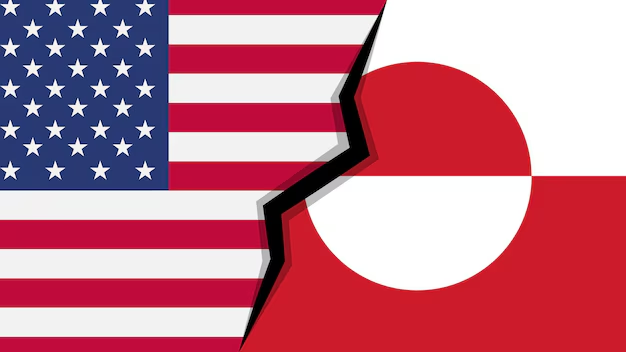
Greenland tariff threat has emerged as the latest geopolitical flashpoint unsettling global markets, after European stocks fell sharply and investors rushed into safe-haven assets amid fresh trade warnings from the United States. The prospect of punitive tariffs tied to Washington’s controversial push to acquire Greenland has revived fears of a wider transatlantic trade rupture, with consequences that extend far beyond trading floors into households, businesses, and long-term economic planning.
European equities opened the week under pressure, reflecting investor unease about escalating political risk. Major indices across France, Germany, Italy, and the wider eurozone slid as markets priced in the possibility of higher trade barriers, disrupted supply chains, and retaliatory measures. Although the dispute is framed around Greenland’s political status, markets are responding to the broader implication: trade policy is once again being used as leverage in geopolitical negotiations, undermining predictability for global commerce.
At the heart of the sell-off lies uncertainty. Markets dislike ambiguity, and the Greenland tariff threat injects precisely that at a time when European businesses were beginning to regain confidence after a turbulent year of inflation shocks and interest-rate volatility. For investors, the concern is not only whether tariffs will be imposed, but how quickly tensions could spiral into a broader trade war that weakens growth across advanced economies.
How the Greenland tariff threat is hitting European industries
The immediate market reaction highlights which sectors are most exposed to renewed trade friction. European automakers were among the hardest hit, with shares sliding to fresh lows. The sector relies heavily on cross-border supply chains and access to the US market, making it particularly vulnerable to tariff escalation. Even the threat of higher duties can force companies to reconsider production plans, delay investment, or absorb higher costs that ultimately filter down to consumers.
Luxury goods firms also came under pressure, reflecting fears that tariffs and slowing global demand could curb discretionary spending. For households, this matters because these industries employ millions across Europe, directly and indirectly. Prolonged weakness could translate into hiring freezes, reduced wages growth, or job losses in regions heavily dependent on manufacturing and exports.
By contrast, defence stocks rallied, underscoring how geopolitical tension often redirects capital toward sectors perceived as beneficiaries of instability. While such gains may buoy certain investors, they also signal a shift in economic priorities, from growth-oriented investment toward security-driven spending, which can crowd out funding for productivity-enhancing projects.
Safe havens surge as the Greenland tariff threat deepens uncertainty
As risk appetite faded, investors turned decisively toward safe-haven assets. Gold and silver prices climbed to new highs, reflecting a broader move away from equities and volatile assets such as cryptocurrencies. This flight to safety is not merely a technical market reaction; it signals eroding confidence in the near-term economic outlook.
For households, rising gold prices are often a warning sign. They typically coincide with expectations of slower growth, currency volatility, or financial stress. A stronger demand for safe havens can also translate into tighter financial conditions, making borrowing more expensive for consumers and small businesses alike.
Currency markets echoed this caution. The euro strengthened modestly against the dollar as investors reassessed US policy risk, while futures markets pointed to a weaker opening for US equities once trading resumes. Together, these signals suggest that the Greenland tariff threat is being interpreted as a global, not regional, risk factor.
Why the Greenland tariff threat matters for households and policymakers
Beyond market volatility, the Greenland tariff threat raises fundamental questions about economic governance and political stability. Tariffs function as a tax on trade, often raising prices for consumers and reducing competitiveness for exporters. If implemented, higher duties on European goods could increase costs for US consumers while squeezing European producers already grappling with energy costs and slowing demand.
For European policymakers, the dilemma is acute. Retaliatory tariffs or the use of economic countermeasures may be politically necessary, but they risk deepening economic pain. At the same time, failing to respond could encourage further coercive tactics, weakening Europe’s negotiating position in future disputes.
Households feel these dynamics indirectly but persistently. Trade disruptions can push up prices, reduce product availability, and slow wage growth. Over time, prolonged uncertainty discourages business investment, limiting job creation and innovation. That is why markets are reacting so sharply: the Greenland tariff threat is not just about one territory, but about the reliability of the global trading system.
As global leaders gather at international forums this week, investors will be watching closely for signals of de-escalation. Whether diplomacy prevails or confrontation hardens will shape not only market sentiment, but the economic reality facing businesses and households worldwide in the months ahead.
Read also: McDonald’s stock lagged the 2025 market rally — Is 2026 a buying opportunity?


