Madagascar Appoints New Prime Minister in Bold Anti-Corruption Move

In a decisive move to stabilize a nation navigating a complex political transition, Madagascar appoints new Prime Minister, Mamitiana Rajaonarison as the country’s new head of government.
The announcement, made Sunday evening via state television, comes less than a week after the President abruptly dissolved the previous cabinet. The appointment of a high-profile anti-corruption expert signals a “clean path” for the Indian Ocean island nation as it prepares for constitutional reforms.
Who Is Mamitiana Rajaonarison?
Mamitiana Rajaonarison’s background makes his appointment particularly noteworthy. Born in 1973 and trained at the École nationale d’administration in France, he has held senior roles in both anti‑corruption and financial oversight sectors. Before assuming the premiership, Rajaonarison directed SAMIFIN, Madagascar’s main body tasked with countering money‑laundering and terrorism financing.
His ascension to Prime Minister is seen by analysts as a strategic move to strengthen institutional integrity and combat longstanding issues of graft, which have hindered economic development and public confidence. Local experts believe his deep understanding of financial crime could help Madagascar attract foreign investment and boost transparency in government operations.
However, some domestic observers caution that Rajaonarison will face significant obstacles in addressing systemic issues that require broader policy and structural reforms, not just anti‑corruption measures.
A Focus on Integrity and “Refoundation”

President Randrianirina’s decision to appoint the former head of the Financial Intelligence Unit (SAMIFIN) appears aimed at restoring public trust. During the ceremony at the Iavoloha Presidential Palace, the President emphasized that the nation requires “incorruptible individuals” to lead its institutions.
“That integrity you have is what I expect from you,” Randrianirina stated during the broadcast. “Show the Malagasy people that the nation needs upright individuals who cannot be swayed or bought.”
The previous administration, led by businessman-turned-politician Herintsalama Rajaonarivelo, was dismissed on March 9. While no official reason was given for the dissolution, analysts suggest the “Refoundation” agenda required a more technocratic approach to combat the illicit financial flows that have long hampered the Malagasy economy.
Who is Mamitiana Rajaonarison?
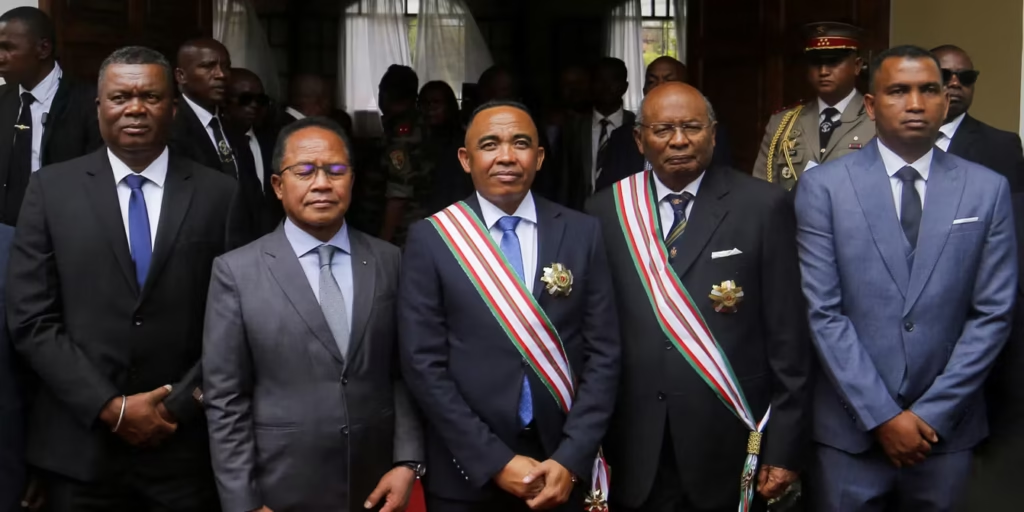
The new Prime Minister is no stranger to the inner workings of Malagasy law enforcement and financial oversight. Since 2021, Rajaonarison has served as the Director General of SAMIFIN, where he spearheaded efforts against money laundering and terrorism financing.
His resume includes a background in the national gendarmerie and senior roles at the Independent Anti-Corruption Bureau (BIANCO). This law-and-order pedigree is a sharp contrast to his predecessor’s private-sector background, suggesting a pivot toward tightening state authority and fiscal discipline.
Public Reaction and Market Stability
Public reaction in the capital, Antananarivo, has been a blend of cautious optimism and scrutiny. Many citizens, particularly the youth movements that fueled the 2025 protests, are waiting to see if the change translates into better service deliveryspecifically regarding the chronic water and electricity shortages.
Civil Society: Groups have welcomed the appointment of an anti-corruption figure but urge the new government to prioritize human rights.
Market Impact: The Malagasy Ariary remained stable following the news, as international investors look for signs of a clear roadmap toward the 2027 presidential elections.
International Observers: The African Union (AU) and SADC continue to monitor the transition, emphasizing the need for an inclusive national dialogue.

Strategic Geopolitics and the Road to 2027
As Madagascar appoints new Prime Minister, the geopolitical stakes remain high. The transitional government has recently courted diverse international partners, including Russia and Japan, for infrastructure and energy projects.
Rajaonarison’s primary task will be to oversee the “Fifth Republic” constitutional drafting process. This transition is expected to culminate in a national referendum and, eventually, a return to full constitutional order through democratic elections scheduled for late 2027.
Conclusion: A Turning Point for Madagascar?
The fact that Madagascar appoints new Prime Minister today is more than a simple reshuffle; it is a calculated attempt to align the executive branch with the military-backed presidency’s reformist image. By placing a career anti-corruption officer at the helm, the transitional authority is betting that transparency will be the key to both internal stability and international legitimacy.
As the new cabinet is formed in the coming days, all eyes will be on Rajaonarison to see if he can successfully navigate the “Refoundation” of a nation at a critical historical crossroads.